Green Indie Publishing


I love print books. I keep my favourites in an old antique bookcase in my lounge room. I have a sentimental attachment to them because they remind me of the time in my life when I read them. Their stories kept me turning the pages while I was cosy in bed or laying on a beach in Mexico or sitting in a cafe in the sun. I love books but I don’t have room to store every book I’ve ever read. Unfortunately, my “recycled” books end up gathering dust in a thrift store warehouse somewhere, never to be read again.

I decided to self-publish Ruthless in print and in eBook form for obvious reasons, but once I became the publisher and not just the reader, I began to think about the impact that decision would have on the environment (if I didn’t, my enviro sister would soon remind me). So I did some research about the impact of print books on the environment. There are lots of different articles, slants and stats on the subject but all that aside, print books = paper = trees= lack of trees= 😦

Createspace (the print publishing arm of Amazon) when questioned on the eco-friendliness of their business responded with the following, which I thought was kind of cool-

Environmental consciousness is important for the continued growth of our company. As a print on demand facility, we only print units as orders come in, which greatly reduces excess production. Additionally, we currently offer a 60# cream paper for black and white book interiors that is made from 30% post consumer waste recycled material. We also maintain a commitment torecycling waste materials that may result from the printing process. We continue to review our manufacturing practices on an ongoing basis to ensure we are doing our part to protect the environment (ref).

So I will be updating Ruthless to use the cream paper instead of white and the next instalment- Heartless will be printed on the same kind.

Also, I found this awesome website Eco-Libris that promotes planting a tree for every book you read (which basically costs $1 per plant). So as well as planting some trees, I’ve decided to reduce the cost of Ruthless in print by $3 so that readers who also love, love, love real books, can spare a dollar to plant a tree too. You can now grab a copy for just $10 USD! Then, when you are finished with it- lend it to a friend 🙂

green publishing

Money on My Mind


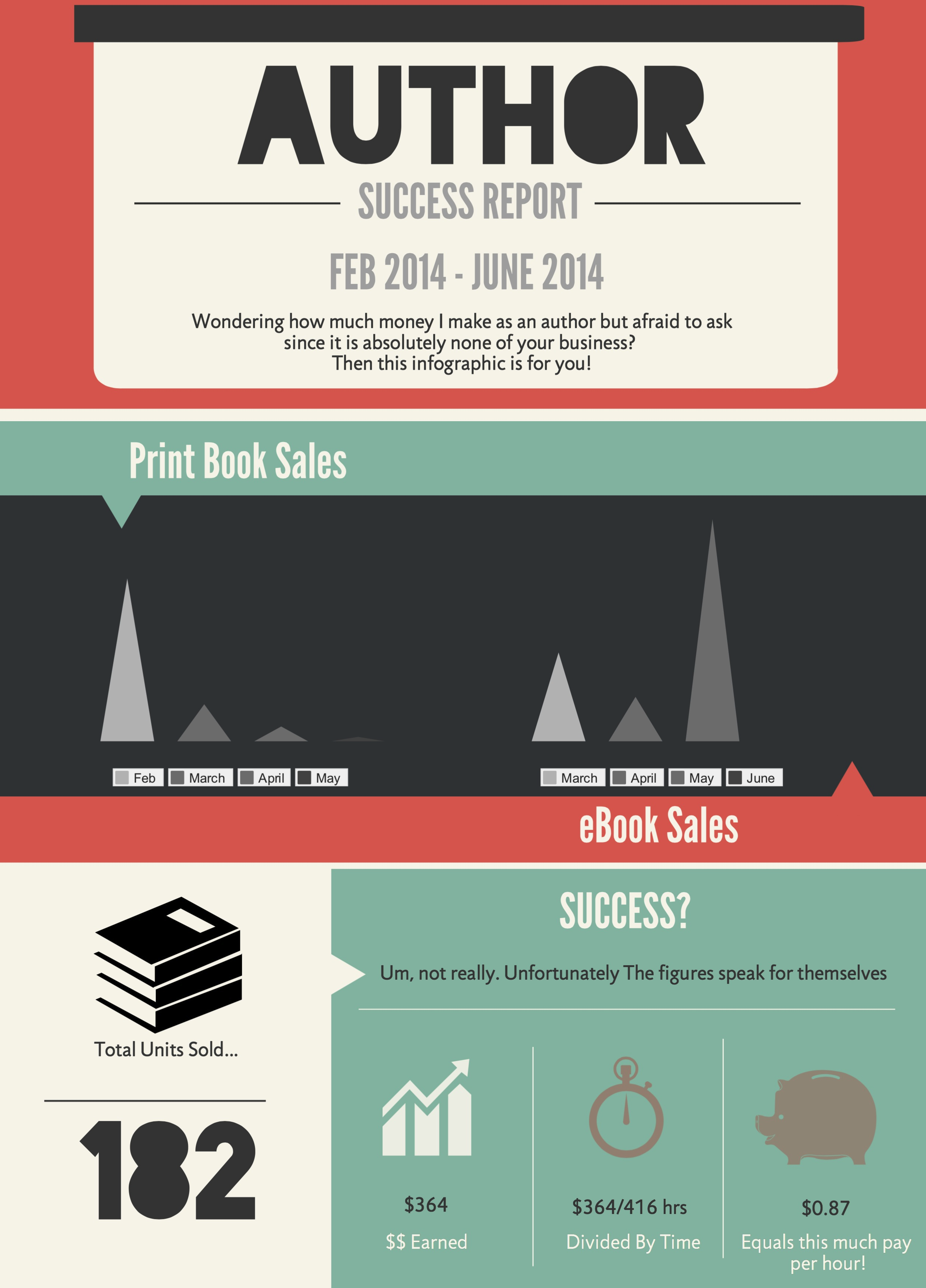
I recently put together an infographic about how “successful” I am as an author (to date). The figures presented are underwhelming, which got me thinking- how else can I support this writing habit of mine? Below are a few ideas…

Affiliate Marketing

Loads of different online retailers do this but I have signed up with Amazon.com. If you decided to buy this copy of Ruthless- by following this link– I would make about 80c on top of my usual royalty. How it works is- you sign up for an account and fill out details about your web site (through which you would be selling items). Then IF you are accepted, you can search for products and generate your affiliate link which you add to your site and hope people will click and buy. I have made almost nothing in this endeavour, but if you feel charitable… click and buy me!
Enesco Hoots N’ Howlers by Lorrie Veasey Nerd Owl Mug, 16-Ounce
Mr Robot Remote Disc Shooting Robot
An Illustrated History of 151 Video Games: A detailed guide to the most important games; explores five decades of game evolution

Competitions

There are a bunch of writers competitions that you can enter and potentially win mula. Some example of competition that don’t have an entrance fee but that offer cash prizes are below:

Freelancer/Fiverr

If you have writing skills that killz then you could always sign yourself up as a freelancer or offer your services on Fiverr.com. Not exactly big bucks on offer but if you are disciplined and can manage a number of orders then it could add up and make a dent in your Gin bill.

Kick Starter

I am seriously considering creating a new project on Kick Starter to fund the second book in the Ruthless trilogy. After paying for all the coffee and breakfast I consume while writing, the book cover design and editing, I am out of pocket quite a bit. Since I have released Ruthless already, I’m hoping folks might see the potential and “back me” to complete the second. Kick starter is basically a way to get interest and donations from the public for any kind of project. You can offer “perks” such as first readings or signed copies etc as a way of enticing people, but ultimately the best method is to get people interested in your product.

https://www.kickstarter.com

Promotions – fire sale

Reducing the cost of your book or writing product in an effort to increase sales is not a bad idea -if done correctly. Speaking of which- I have a promotion on Amazon UK coming up on June 13th-19th 2014, when Ruthless will go down to 0.99p for the week. Bargain!

How successful are you?


People often ask me “How many books have you sold?” which innocently translate to “How successful are you?” The faux pas in this case seems to get lost in the person’s good will and excitement about the fact that I am now a published author. I completely understand, but at the same time, I wouldn’t dream of asking my real-estate agent friend, how many houses he had sold and the resulting commission. It is an odd question that pokes it’s toe across a line that probably shouldn’t be crossed.

Perhaps I am being overly sensitive, or I am starting to crack after answering the question so many times by modestly guessing the number of books I’ve sold based on the last time I’d checked (which is usually a month ago or more). Regardless, I have created an infographic that I can point curious  friends and acquaintances at, instead of bumbling through an inaccurate response. It is meant to be a bit of fun 🙂 I hope you like it.

https://magic.piktochart.com/output/2103105-writing-success

Esther Krogdahl's success as an author

The Perfect Synopsis


I published Ruthless back in February 2014 and slowly I have been gathering readers and buyers online. One element of the book I have recently changed in order to improve interest and sales, is the synopsis. Using wattpad, I can see how many users are reading the synopsis and then deciding NOT to continue on with the story. Unfortunately, there have been many. So I went back and reviewed the “hook of the book” and found it was not nearly as catchy and gripping as it could be.

The synopsis is really as important, or perhaps even more so, than the book cover design. It needs to pull readers in- quickly! My synopsis for Ruthless was a little slow and only really got to the intriguing part after 2 paragraphs. I changed it up on wattpad first and then updated Amazon after I saw a significant increase in reads. This is what I ended up with:

Corporate life just became deadly. Succeed or seek salvation…

When career-driven Ruth lands a seemingly perfect job at GlobalCore- a chic yet mysterious global corporation, she prepares to dish out her cold and merciless brand of Human Resource Management. But there is something different about this company… Ruth soon finds herself climbing the corporate ladder but this time as a matter of life or death. She must compete with industrious angels, hell-bent on success, as she struggles with her new eternal occupation that redefines “employee termination”. Follow Ruth as she delivers damning employee evaluations to the most wicked souls that California has to offer. These aren’t the mild-mannered office workers Ruth is used to firing, these employees are rotten to the core, and they won’t be leaving without a fight.

So how does one write the perfect synopsis? First of all, I think keep it short and punchy. Originally, mine was quite long as I felt I needed some real content on the back of the book- not just a few lines. Not necessary. Have a look at some of the more popular author’s books. They are mostly covered with review quotes- not the synopsis.

Secondly, don’t be afraid to start with a teaser line at the top. I used Corporate life just became deadly. Succeed or seek salvation… This will serve to pull the reader in if it is something bold or mysterious and it may also help you when readers are searching for your book online. Often, search engines- whether they be built in to applications like wattpad or Amazon, will only return a snip it of a synopsis or book description. Usually, just the first line or two, so make you point in that first line. Make it interesting.

Don’t give too much away. In my case, I have planted twists and turns throughout Ruthless so it was hard not to give some of those away by describing events in the story. You want to offer a teaser of what is inside so people will actually want to read the book. If they feel like they have the whole story from reading the back, then they are going to just put it down and move on. It is a tricky balancing act but you also don’t want to be too abstract or ambiguous. Aim for something in the middle.

I am about to publish my second book and the sequel to Ruthless so I am beginning to write the synopsis for Heartless now. I’ll publish on my blog soon. I’d love to hear your comments.

Presence vs. Imagination


I’m a bit of a dreamer. Most people wouldn’t know it mind you because I hide it well. I have always had this uncanny ability to take in what someone is saying to me even though I’m not listening- I’m off somewhere else in my mind.

So recently I have been reading into “How to be more present”. Why? Well, because day dreaming has it’s down sides. Often it will see me reliving an unpleasant event of the past or worrying about something that may not even happen in the future. There is a good case made by tinybuddha.com here.

So I am trying to make an effort to be present and keep myself in the moment, but then I find myself asking- is this at the cost of my creativity and imagination? If I practice being present, will I lose or weaken my ability to day dream? I mean, I’ve had some of my best ideas while my manager at work is rambling on about something I should really be paying attention to.

So I’m interested in hearing from creative crew who have also come across this forked path and chosen to live in the moment. Are you still as creative and imaginative as you once were?

Writing Process Blog Tour


Jennifer Ellis author of In the Shadows of the Mosquito Constellation, recently tagged me to join the Writing Process Blog Tour.

If you are tagged, you are to write responses to the questions below and then tag three other authors.

At the bottom of this post I hope to add three indie author bios and pass the tour on to them. If you’d like to be tagged in this post please leave me a comment and I will contact you and update.

The Questions

What am I working on?

I am currently working on the sequel to Ruthless. At this stage I am going with the title Fearless but that could change. Fearless will continue with Ruth understanding a lot more about her ‘eternal circumstances’ and doing a lot more ass-kicking of bad guys. I don’t want to give too much away for those who haven’t read Ruthless, but there are plenty more twists and turns in the plot line and you won’t see them coming!

Aside from Fearless I am also developing a text adventure game using the Wibble’s Quest framework. It is lots of fun and is helping me develop a new style of writing for games (which I love to play). Text adventures have always been a retro favourite of mine- there is nothing like using only your imagination to conjure scenes in which you are interacting.

How does my work differ from others of its genre?

I like to throw in plot twists like no other. I also try to move my stories and characters into a complete circle with earlier ideas, actions and attitudes being explained or tied in at the end. I like to think my writing style is easy to read and my stories are short but sweet.

Why do I write what I do?

Because it is bursting out of my brain onto my keyboard. I don’t put too much thought into hidden meanings or agendas in my writing, although there definitely are some embedded in Ruthless – as a writer, I don’t think you can help it.

I have always been a fan of action and adventure and so far my stories and ideas have followed the same genre. Ultimately I enjoy writing and that is why I do it. I am not writing for a market (unfortunately for my pockets), I am writing what I would like to read.

How does my writing process work?

I have written some other posts describing my process here, but basically I do a rough storyboard which is drawn around a circle. I call out the important points in the plot e.g.  the addition or death of a character, an action scene or a key realisation.

I then just get down to writing. I know how much a story can change as you write and after an edit so there is no point spending hours and hours storyboarding and getting overly attached to your plan. I like to let my story be fluid and I’ve been known to remove entire chapters because they no longer align with my idea of a character or support the story’s backbone.

After I am about 80-90% complete, I get my manuscript to a good editor and then edit the book based on their recommendations and report. For Ruthless, I used 2 separate editors about 3 months apart.

Who’s Up NEXT Week (or so)?

I’m waiting to hear from any authors who are interested in continuing this blog tour. If you are keen, please leave a comment and I can tag you with a link to your blog.


What is Wattpad?


Wattpad is for anyone with an interest in books. It is reader/writer social media and it is free to join! It is an excellent way to reach your readers and get feedback and comments on your work. wattpad is mainly a YA scene so if your interests or writing genre is outside of that realm it might not be for you. If you publish your work there, you are essentially giving it away for free too. I wouldn’t recommend just publishing a taster either- users on wattpad want the full version and if they only get half of the story, they probably won’t be interested in following you.

I have published a few chapters of Ruthless there and I will be slowly adding more each week: http://www.wattpad.com/47288277-ruthless-chapter-1. Posting on weekends is a good way to pop up on current content searches. I haven’t really had much success with comments and feedback yet but the most valuable feature for me has been being able to track the number of reads on each chapter and my synopsis. You can actually see how many people ‘read on’ which gives you an indication of the strength of your writing.

If you would like to connect with me and give some feedback on wattpad I would LOVE to hear it.

An Assignment


Kelvin Abbott dusted his hands against his stone washed jeans before examining them in the waning light. He’d gotten blood under his fingernails again and now the dirt from digging had mingled with it to create black arcs at the tips of his fingers. He’d have to wash up before he went back inside. Jillian knew better than to stick her sniveling nose in his business but still, he didn’t need to invite questions. It had already taken him two and a half hours to dig the hole- much more time than was realistically needed to burry a junkyard dog. His dim-witted wife wouldn’t know the difference anyway, she’d never suspect looking at the size of the hole. She’d be too stupid to consider that it was the depth of the hole, not the width that mattered. The duffle bag containing the folded child took up no space at all but it had to be buried deep. After the duffle bag was inside, he’d need to cover it with two feet of dirt before adding the stinking dog he’d run down that day. Filling the hole would be the culmination of all his hard work. It would make the thing final – a success.

Kelvin wiped the sweat from his brow with his forearm and straightened is aching back. At forty-four, he was fit and strong enough to be digging holes in the stony earth of Woodlake Californian, but it was still hard work. He kicked the loose dirt from his work boots and moseyed over to the blue duffle bag that was tucked just underneath the house. The bag was brand new – had never been used- on account of the fact he’d bought it just yesterday. Kelvin grasped the black handles and dragged the bag along the ground towards the hole. As he neared the edge, he had to come around and spread his legs on either side, before grabbing the bag handles again and pulling the bag inside. It landed with a wet thud.

Kelvin took two steps backwards, steadying himself with his shovel, wedged in the mound of dirt he’d extracted from the hole. Pulling it out, he pushed the top layer of soil into the hole. He did this until a quarter of the mound had disappeared. Finally he stood back, scratched his head and surveyed the yard.

The dog lay out in the open only a few feet away, its vacant black eyes staring up at Kelvin as he made his way over. He kicked it in the belly and sent it launching towards the hole. He’d overshot it. The dead dog landed on the edge of the hole but didn’t fall inside. Prickling pins of rage sent a burning sensation over Kelvin’s shoulders and into his arms. It made him stronger and more determined, like a bull that has seen the flash of the matador’s red cape.

Kelvin marched over to the hole, grasping the shovel on the way and brought the edge down hard on the dog’s neck, lopping it clean off. The rest of the dogs body slid into the hole as Kelvin gritted his yellowed teeth in a horrific smile. He then turned the bloody tool in his hands and held it like a golf putter, gently knocking the dog’s head into the hole. He grinned with tight lips and then spat into the hole, before taking a shovel full of dirt and unloading it onto the bloody mess beneath him.

An Indie Author Timeline


While attending a seminar called ‘Standing out in the crowd’ with Susan May, I got the impression that many of the budding authors in the room wanted to know what steps to take to become an indie author. Although in a number of my posts I provide advice around specific steps I’ve taken, I haven’t yet pieced them altogether so folks can see the whole “journey”. So here it is:

1) Storyboard your idea. There are many ways to do this and plenty of tips online. A storyboard doesn’t have to be detailed but should outline the key points in your plot. I simply list out the important events in chronological order, including main character introductions.

2) Start writing. In my case I started with a fantasy novel but you could be writing a short story, a biography or a novella. The important thing is get to it. It doesn’t have to be perfect yet- you’ll develop your style and technique as you go. Certainly having a good grasp of grammar is important (Google can help) but it is not essential. An editor can help point out your weaknesses in the editing phase later.

3) Keep writing. I wrote a post about finding the time to write. It’s hard when you have a full time job or a family to look after, but you can do it. Keep plugging on until you feel you are 80% completed (for a novel I would say this is the 35-40,000 word mark). Make sure you read over your work and do a self-edit or two. Again, it doesn’t have to be perfect but you might find some clear contradictions or statements that don’t make sense. You may find some of what you have written is no longer needed and can be removed.

4) Find a good editor. People always want to know how to find a good editor. In my case it was luck. There are plenty of web sites offering editing services online. Look at your local writers guild web site, go to a writers group, open the phone book. There are plenty around advertising their services, you just need to find one that is right for you. I suggest picking one that usually edits and/or writes in the same genre as you.

5) Submit to your editor. Now you have some time off from writing! How long depends on how long your submission is- for approx 40,000 words I’d say you’ve got 1-2 months of waiting. Now I suggest you start researching your market and looking at how you will market yourself as an indie author. Social media is a big one and you should really think about setting up a blog or a web site to reach your future readers. You don’t need to spend any money here, there are plenty of free DIY sites (blogger, wordpress, etc). Check out my Author Pimpin with Social Media post.

6) Take your editor comments on board and get to editing your work. This post about how many times you should edit your book might help. Because I had a great editor who I really respected, I basically did what ever she suggested, bar a few suggestions that clashed with my new found style of writing.

7) Finish your book and write a synopsis. I bet you found you had to remove great chunks after your edit. Its funny how what seemed important when we started writing a chapter became irrelevant to the storyline after a few more. For tips on how to keep going until you get to the end, check out my post called How to Finish Writing a Book. Nail a good synopsis that briefly describes your story without giving too much away. The synopsis should draw your readers in.

8) Send your book and synopsis to another Editor (or the same one if that suits). I like to get a second opinion and focus my second edit more on grammar and structure. At this stage, I’d suggest asking others to proof read your work as well. Family and friends are best. Check out my post on the Best Kind of Proofer.

9) Decide if Indie is for you. There are pros and cons for Indie vs. Traditional publishing. The biggest con for Indie as far as I have experienced is – doing your own marketing. It can seem like a full time job. If you don’t market yourself and your books, its very unlikely you will sell any. It takes time, effort and dedication. There are a bunch of other considerations though and its up to you to research them and decide what is right for you.

10) If Indie IS for you- then transfer your manuscript into the revenant self-publishing document template. It could be for eBook or print. I would focus on one first and see what is involved. If going with Amazon, you need to decide your book dimensions first and then download the relevant template. You could always start with a template when you start writing but I didn’t, it was easy enough to copy and paste each chapter into the template chapters. You can fill out the Title, dedication and acknowledgement sections. Don’t delete the blank pages in between because these are pages in your book now. There are a bunch of people that can help you with formatting. Just like editors, their services are advertised all over the place- you just need to look. I did all the formatting myself, which did take me a while but it cost me nothing 🙂 Once you have transferred your chapters, your book needs another good proof read- but this time, you should be checking formatting, page numbers, line spacing etc while you read through the story.

11) Design a book cover. Again, this is something you can do yourself or you can pay someone to do it. Doing it yourself requires the right tools (e.g. Illustrator). I did it myself but that was risky. Your cover is the first thing people see so it MUST look professional. You can buy covers online or hook up with a designer and tell them what you want.

12) Sign up for a “publishing site” account. In my case, I used Createspace but you could use Smashwords instead (note: these sites use different templates so make sure you’ve used the right one). You don’t need to upload your book yet but you can do if you like. It will be subject to an automated check which takes about 24 hours. You can fill out all the details about your book like the synopsis, title, whether it is part of a series etc. You also need to choose your distribution options and your costing model. This requires a bit of thought and I suggest researching other books similar to yours online to see what is an acceptable price. You need to consider whether you are publishing print, ebook or both and the prices should differ depending on the medium. You might also want to think about your Tax situation. In my case, because I wanted to sell my book on Amazon.com and I am an Australian, I had to do some work to get a TFN in the US. Check out my post here for help.

13) Upload your book and cover image then wait for approval. Once you get it, use the virtual reviewer to see how your book is laid out (Createspace has a virtual page-turning software). This is important as your book needs to look like a real book- not just a manuscript. Content should be on the right pages and blank pages should split out your title and dedication pages from your chapters. I recommend (and I did this) ordering proof copies. If you are publishing a print book, you can have copies sent to you so you can feel it under your fingers and flick through yourself. It is a cause for celebration when you hold your first book in your hands!

14) Publish that sucker! Once you are happy with it- press the big red button and release it. Sometimes this can take several days to appear in “stores” but before then you should be able to order “author copies”. You may want to sell these at a book launch or some such cool event.

15) Finally, market yourself like a demon! Send out links to buy copies of your book on social media, come up with promotions and opportunities to promote yourself as an author. Contact local papers and radio stations and offer to speak at events. This is the hardest part  so be prepared. Don’t expect to sell 1000s in the first few months. You can also look at “special” offers available through your publisher such as KDP Select (for eBooks). You need to research this stuff before you sign up. There are plenty of opinions online- here is one of mine.

So there you have it. If you want to see the product of my journey, you can order a copy Ruthless from Amazon in print or eBook. I’d really appreciate your support.